
Devices & Frames
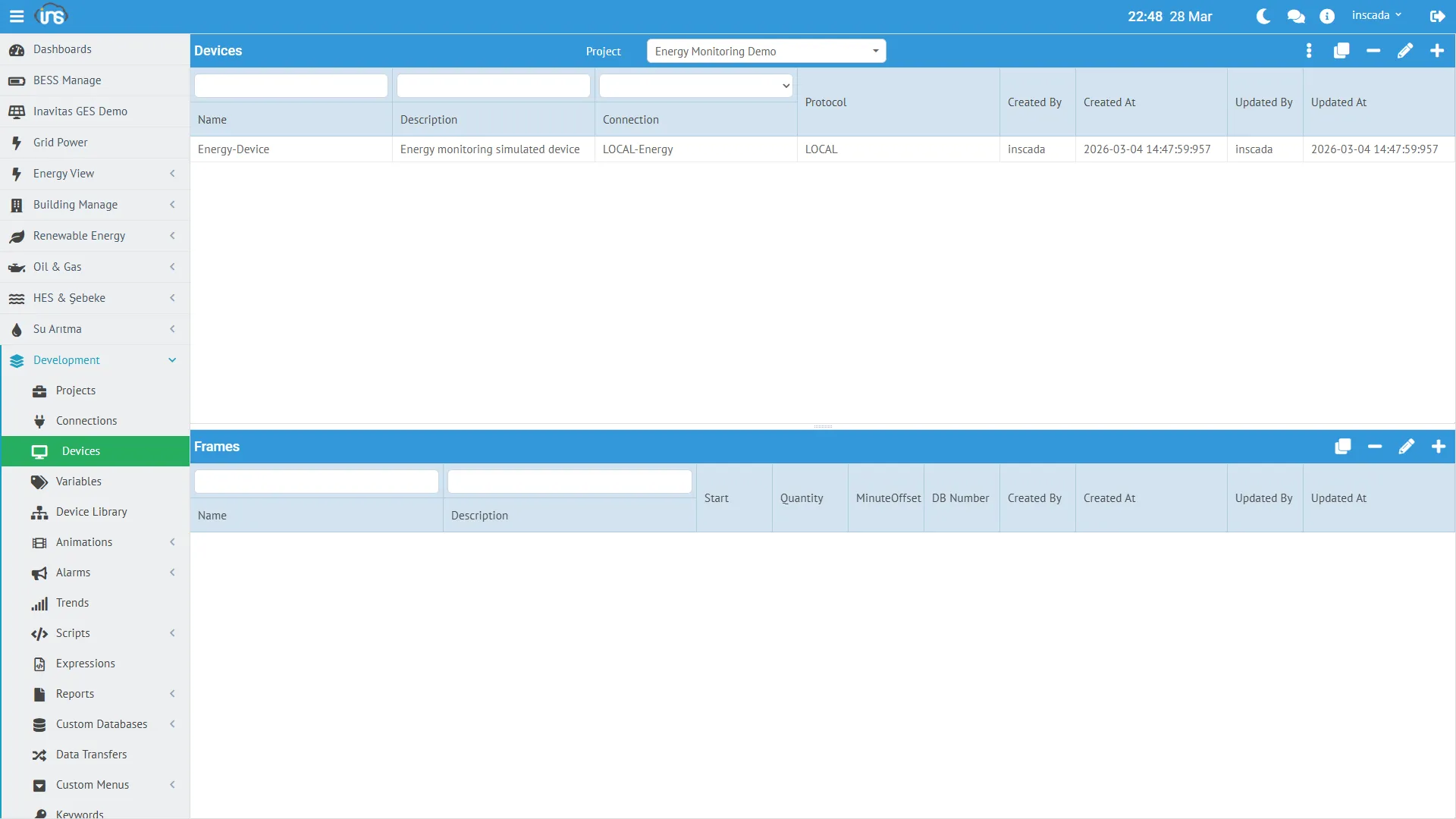
Device
Section titled “Device”A device represents a physical or logical unit over a connection. A single connection can host many devices — for example, multiple slaves on a Modbus TCP link.
Device Fields
Section titled “Device Fields”Common fields:
| Field | Type | Required | Description |
|---|---|---|---|
| name | String (≤100) | Yes | Device name (unique within the connection) |
| dsc | String (≤255) | No | Description |
| protocol | Protocol | Auto | Inherited from the parent connection |
| connectionId | String | Yes | Owning connection ID |
| config | Map | Protocol-dependent | Protocol-specific settings (JSONB) |
Fields that appear at the top level of the device JSON come from config — inSCADA flattens the DTO. For Modbus the device-level fields are:
| Field | Type | Description |
|---|---|---|
| scanTime | Integer (≥100) | Read cycle (ms) |
| scanType | DeviceScanType | Periodic or Fixed Delay |
| stationAddress | Integer (≥0) | Modbus slave address |
Scan Type
Section titled “Scan Type”The DeviceScanType enum has two values:
| Value | Behavior |
|---|---|
| Periodic | Fixed-rate scheduling — the period between cycle starts stays at scanTime |
| Fixed Delay | Fixed-delay scheduling — scanTime is inserted after each cycle ends |
Device JSON (Modbus example)
Section titled “Device JSON (Modbus example)”{ "id": "abc123", "connectionId": "conn-153", "protocol": "Modbus TCP", "name": "slave-1", "dsc": "Energy meter", "scanTime": 2000, "scanType": "Periodic", "stationAddress": 1}Scan Time Recommendations
Section titled “Scan Time Recommendations”| Scenario | Suggested scanTime |
|---|---|
| Fast-changing data (power, current) | 1000 – 2000 ms |
| Medium-rate data (temperature, pressure) | 3000 – 5000 ms |
| Slow-changing data (energy meter) | 5000 – 10000 ms |
| Status bits (on/off) | 1000 – 3000 ms |
A frame is a block of data read from a device. Each frame defines an address range. Variables live inside frames.
Frame Fields
Section titled “Frame Fields”Common fields:
| Field | Type | Required | Description |
|---|---|---|---|
| name | String (≤100) | Yes | Frame name |
| dsc | String (≤255) | No | Description |
| deviceId | String | Yes | Owning device ID |
| protocol | Protocol | Auto | Inherited from the device |
| isReadable | Boolean | Yes | Whether the frame is polled |
| isWritable | Boolean | Yes | Whether variables in this frame can be written |
| scanTimeFactor | Integer | No | Multiplier on device scanTime (null or 1 → same period) |
| minutesOffset | Integer | No | Schedule offset in minutes (e.g. on-the-hour alignment) |
| config | Map | Protocol-dependent | Protocol-specific fields (JSONB) |
For Modbus the frame config fields are:
| Field | Type | Description |
|---|---|---|
| type | ModbusFrameType | Frame type (Coil, DiscreteInput, HoldingRegister, InputRegister) |
| startAddress | Integer (0-65535) | First address to read |
| quantity | Integer (1-1024) | Number of registers/coils to read |
| interFrameDelay | Integer | Delay between frames (ms) |
Frame JSON (Modbus example)
Section titled “Frame JSON (Modbus example)”{ "id": "frame-703", "deviceId": "dev-453", "protocol": "Modbus TCP", "name": "holding-block", "dsc": "Holding registers 0-49", "isReadable": true, "isWritable": true, "scanTimeFactor": null, "minutesOffset": null, "type": "HoldingRegister", "startAddress": 0, "quantity": 50}Readable / Writable
Section titled “Readable / Writable”| Setting | Meaning |
|---|---|
| isReadable = true | Frame is polled (monitoring) |
| isWritable = true | Variables in the frame accept writes (control) |
Both true | Read + write — the most common case |
| isReadable = false | Write-only frame (setpoint dispatch) |
Scan Time Factor
Section titled “Scan Time Factor”Sets the frame’s read period as a multiple of the device scanTime:
- Device scanTime = 2000 ms, frame scanTimeFactor = 3 → frame is polled every 6000 ms
nullor1→ same period as the device
Hierarchy Summary
Section titled “Hierarchy Summary”Connection: LOCAL-Energy (LOCAL, 127.0.0.1)└── Device: Energy-Device (scanTime: 2000 ms, Periodic) └── Frame: Energy-Frame (readable + writable) ├── ActivePower_kW (Float, kW) ├── ReactivePower_kVAR (Float, kVAR) ├── Voltage_V (Float, V) ├── Current_A (Float, A) ├── Frequency_Hz (Float, Hz) ├── PowerFactor (Float) ├── Energy_kWh (Float, kWh) ├── Temperature_C (Float, °C) ├── Demand_kW (Float, kW) └── GridStatus (Boolean)The shape is identical on a Modbus TCP link — the only change is that device- and frame-level protocol-specific fields (stationAddress, type, startAddress, quantity, …) are added.
Reading and updating devices / frames from scripts: Connection API →